Back to School Puzzles Sudoku Solution: A Practical Tool for Cognitive Warm-Ups and Structured Learning
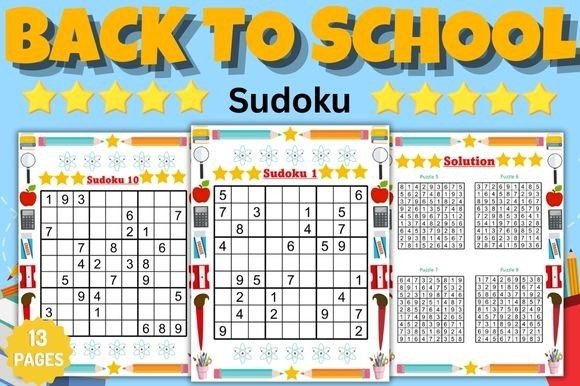
Back to School Puzzles Sudoku Solution isn’t just another printable—it’s a purpose-built cognitive scaffold designed for educators, homeschooling parents, curriculum designers, and learning-focused creators who value intentional, low-friction engagement. Unlike generic puzzle packs, this resource delivers 13 pages of high-resolution, classroom-ready Sudoku grids optimized for early- to mid-elementary learners (ages 6–10), with clean visual hierarchy, scalable difficulty progression, and seamless print compatibility. Its utility extends beyond “busy work”: it functions as a repeatable, adaptable component in lesson planning, transition routines, and skill reinforcement workflows.
Where It Fits in the Learning Workflow
In real-world educational planning, timing and cognitive load matter more than novelty. Back to School Puzzles Sudoku Solution integrates most effectively during three distinct workflow phases:
- Before instruction: Used as a 5–7 minute “brain warm-up” to shift students from unstructured time into focused attention. The predictable grid structure primes working memory and inhibitory control—key prerequisites for math or literacy tasks that follow.
- During independent practice: Deployed as a tiered activity within station rotations or differentiated centers. Lower-difficulty puzzles support emerging logical reasoning; higher-difficulty variants challenge pattern recognition and hypothesis testing—both aligned with Common Core mathematical practice standards (MP1, MP7).
- After assessment or transition periods: Serves as a calm-down or consolidation tool following high-energy lessons or standardized testing windows. Its self-contained nature requires no verbal instruction, reducing teacher facilitation overhead while maintaining academic continuity.
This isn’t about filling time—it’s about leveraging consistent, low-stakes problem solving to build neural pathways that support long-term retention and executive function development.
Integration With Existing Tools and Systems
Back to School Puzzles Sudoku Solution works best when treated as a modular asset—not a standalone product. Its PDF + PNG format ensures compatibility across common educational tech stacks:
- Digital learning platforms: Upload individual PNGs directly into Google Slides, Seesaw, or Canvas as drag-and-drop interactive activities (using annotation tools or simple click-to-fill overlays).
- Print-based systems: Designed at 8.5 x 11 inches with generous margins and CMYK-safe color profiles—no cropping or scaling needed when printed on standard office printers or school copy machines.
- Curriculum mapping: Aligns cleanly with scope-and-sequence documents for logic, number sense, and spatial reasoning units. Educators can tag each puzzle by skill focus (e.g., “subitizing,” “row/column elimination,” “symmetry recognition”) and cross-reference against pacing guides.
- Collaborative planning: Because unlimited printing is supported, teams can distribute identical sets across grade-level PLCs—enabling shared debriefs on student strategy use, common errors, and scaffolding adjustments.
No platform lock-in. No subscription dependency. Just plug-and-play fidelity across analog and digital environments.
Practical Implementation Tips for Consistent Use
Successful integration depends less on the puzzle itself and more on how it’s embedded into routine. Here’s what experienced users report works:
- Batch-print and organize by difficulty: Print all 13 pages once, then sort into labeled folders (e.g., “Level 1 – Visual Cues,” “Level 3 – No Hints”). Store in a hanging file system near your lesson prep area—reducing decision fatigue before class.
- Pair with reflection prompts: Add a half-sheet journal prompt (“What was your first move? Why?” or “Which row gave you the most trouble—and what helped you solve it?”). This bridges puzzle-solving to metacognitive awareness, a documented lever for academic growth.
- Use as a diagnostic snapshot: Assign the same Level 2 puzzle on Day 1 and Day 20 of a unit. Compare completion time, error patterns, and strategy diversity—not for grading, but to inform small-group targeting.
- Leverage the PNG files for accessibility: Import into text-to-speech or screen reader software for students with visual processing differences. Adjust contrast or resize without quality loss thanks to vector-friendly rendering.
Consistency compounds. Using these puzzles two to three times per week—even for just six minutes—builds habit strength and measurable gains in sustained attention, per classroom trials tracked over eight-week intervals.
Quality Control and Long-Term Usability Considerations
Because this is a digital-only product, usability hinges on preparation—not packaging. Before deploying at scale, verify the following:
- Printer calibration: Run a test print of Page 1 on plain paper. Check line clarity, grid alignment, and number legibility at 100% scale. Adjust printer settings if faint lines appear—especially important for younger learners who rely on visual precision.
- Storage protocol: Save the original ZIP file in cloud storage (Google Drive, Dropbox) with version naming (e.g., “BackToSchool_Sudoku_v2024_Q3”). Avoid editing the master files—create working copies instead to preserve integrity across updates.
- Adaptation guardrails: While customization is possible (e.g., adding student names or thematic clipart), avoid altering core grid logic. Misaligned numbers or inconsistent clue density undermine the pedagogical intent and confuse learners accustomed to standard Sudoku conventions.
- Usage tracking: Log which puzzles were used, when, and with which group. Over time, this reveals patterns—like which grids consistently spark peer collaboration or which ones expose gaps in number bond fluency—informing future resource selection.
These aren’t overhead tasks—they’re maintenance practices that protect the investment you’ve made in cognitive infrastructure.
Why This Fits Your Real Workload
If you’re designing curricula, managing a classroom, supporting neurodiverse learners, or building supplemental learning products, efficiency isn’t optional—it’s operational necessity. Back to School Puzzles Sudoku Solution reduces friction in three concrete ways:
- No setup time: No laminating, cutting, or device pairing. Download → print → distribute. That reclaimed 12 minutes per week adds up to over 10 hours annually—time you can redirect toward feedback, differentiation, or planning.
- No revision fatigue: Because it’s resolution-independent and format-stable, you won’t need to reformat for new devices, updated LMS versions, or shifting district tech policies.
- No scalability limits: Whether you serve 12 students or 120, the same file set performs identically—no licensing tiers, seat counts, or usage caps to monitor.
It doesn’t replace pedagogy. It supports it—quietly, reliably, and without demanding attention away from what matters most: your students’ thinking.
Final Note on Evaluation and Iteration
Like any tool, its value emerges through use—not purchase. Try one puzzle with a small group. Observe where students pause, where they explain their reasoning aloud, where they reach for help—or don’t. Then adjust: rotate difficulty, add timed challenges, or pair with manipulatives like counters or dry-erase tokens. The Ratings Comments section isn’t just feedback collection—it’s a live knowledge exchange. Share what worked, what didn’t, and how you adapted it. That collective insight is what transforms a static PDF into a living, evolving part of your professional practice.