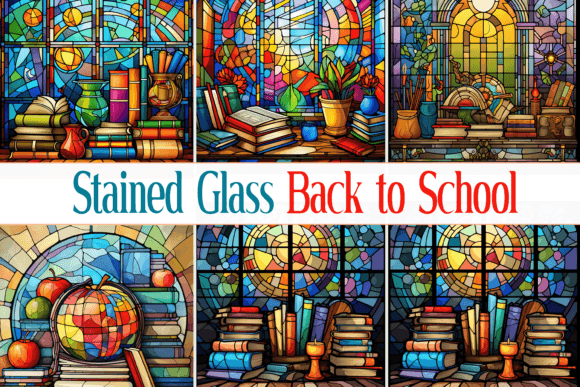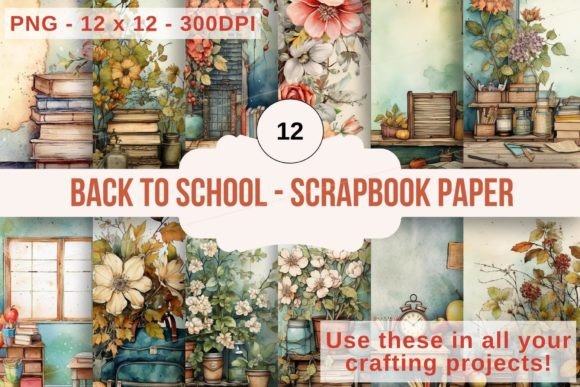
Back to School Scrapbook Papers 03: A Thoughtful Digital Resource for Meaningful Memory-Making
Back to School Scrapbook Papers 03 stands apart—not as a generic seasonal design pack, but as a deliberately composed set of digital papers grounded in tactile warmth, educational resonance, and quiet authenticity. Unlike mass-produced clipart bundles or algorithmically saturated templates, this collection embraces the subtle irregularities inherent in AI-assisted creation: slight texture variances, organic line weight shifts, and gentle color gradients that mimic hand-painted paper rather than sterile vector perfection. These are not flaws to be corrected—they’re intentional signatures of human-aligned design thinking, making each sheet feel like a found artifact from a well-loved classroom archive.
How Back to School Scrapbook Papers 03 Supports Diverse Creative Workflows
The utility of this collection emerges most clearly when mapped against real creative workflows—not abstract “use cases,” but the actual rhythms of how people make things. Educators preparing first-day welcome posters often begin with layout sketches on scrap paper before moving to digital tools. Back to School Scrapbook Papers 03 bridges that transition seamlessly: its 300 DPI PNG files retain crisp detail whether scaled down for a 4×6 photo mat or enlarged for an 18×24 bulletin board display. A third-grade teacher in Portland recently used Paper #07—a soft watercolor wash with faint chalkboard grid lines—to anchor a student-led “My Learning Goals” wall display. The texture absorbed marker annotations without bleeding, while the underlying structure subtly reinforced spatial reasoning concepts.
For journaling artists and mixed-media hobbyists, the collection functions as both substrate and inspiration. Its inclusion of lightly distressed edges, subtle ink blots, and faint pencil-line borders invites layering—not just visually, but conceptually. One illustrator in Austin built a Junk Journal series around Paper #12 (a sepia-toned ledger-style sheet with faded arithmetic equations), using it as a base for collaged math vocabulary cards, pressed autumn leaves, and handwritten reflections on growth mindset. The paper didn’t dominate; it conversed with the other elements, lending historical weight without competing for attention.
Parents documenting milestone transitions—kindergarten orientation, middle school locker assignments, senior year schedules—find particular value in the tonal range. Rather than defaulting to bright primary colors alone, Back to School Scrapbook Papers 03 includes muted sage greens, dusty rose washes, and warm oatmeal neutrals. These palettes support emotional nuance: a nervous first-day photo feels grounded against a soft linen-textured paper, while a triumphant science fair ribbon gains quiet dignity beside a subtle graph-paper overlay.
Technical Integrity Meets Practical Flexibility
Each file in the Back to School Scrapbook Papers 03 collection is delivered as a standalone PNG with transparent background capability—no forced white borders, no locked layers, no proprietary software dependencies. This isn’t merely a convenience; it’s a commitment to interoperability across platforms and skill levels. A homeschool parent using Canva can drag and drop a paper directly into a custom planner template. A graphic designer working in Affinity Designer can isolate individual textures via layer blending modes. Even educators with limited tech access can print single sheets on standard letter-size cardstock and cut them by hand for physical bulletin boards or student-made greeting cards.
The 300 DPI resolution ensures fidelity without bloat: average file size remains under 4 MB per sheet, enabling smooth performance even on older devices or shared school lab computers. There’s no need for cloud syncing or subscription-based asset libraries—once downloaded, the files reside locally, editable, printable, and reusable without time limits or usage caps. This permanence matters deeply in educational contexts where budget cycles shift, platform licenses expire, and institutional IT policies restrict external downloads.
Design Philosophy Rooted in Educational Psychology
What distinguishes Back to School Scrapbook Papers 03 from trend-driven alternatives is its alignment with research on visual cognition and memory encoding. Studies in cognitive psychology suggest that moderate visual complexity—neither overwhelming nor barren—supports deeper information retention. The papers avoid dense all-over patterns in favor of balanced negative space, strategic focal points (like a single vintage compass rose in the corner or a discreet row of lined notebook margins), and harmonized color families that reduce perceptual load.
Consider Paper #04: a pale sky-blue ground overlaid with faint, spaced-out pencil lines mimicking ruled notebook paper. It doesn’t shout “school!”—it whispers familiarity. For neurodivergent learners or students recovering from pandemic-related learning disruptions, that whisper carries reassurance. The consistency of line spacing supports visual tracking during writing tasks; the low-saturation blue reduces glare-induced fatigue during extended screen-based journaling sessions. These aren’t aesthetic afterthoughts—they’re embedded accommodations.
Real-World Integration Across Roles and Settings
In classroom settings, these papers serve dual purposes: functional tool and implicit curriculum. A high school history teacher in Ohio uses Paper #19—a parchment-style sheet with faint typewriter font headers reading “September 1923” and “October 1965”—as the base for student-created timelines. The implied historical layering encourages critical thinking about chronology and context, while the tactile suggestion of aged paper fosters engagement with primary sources.
For small business owners running tutoring studios or enrichment programs, Back to School Scrapbook Papers 03 provides brand-consistent yet adaptable assets. A literacy coach in Nashville built her entire fall newsletter series around Paper #02 (a warm beige with delicate botanical sketches), adjusting only text color and font to match her logo palette. Because the underlying design remains consistent, families recognize continuity across touchpoints—email headers, printed progress reports, and digital goal trackers—without requiring custom illustration budgets.
Researchers studying family engagement in education have also adopted the collection for participatory documentation methods. In a recent pilot study at the University of Georgia, caregivers were given printed sheets from Back to School Scrapbook Papers 03 alongside blank journals and asked to document “one thing my child taught me this week.” The gentle structure of the papers lowered barriers to entry—especially among participants with limited formal writing experience—while the nostalgic tone invited vulnerability and reflection.
Responsible Use and Ethical Considerations
Because these are digital files intended for repeated personal and educational use, understanding scope of license is essential. The collection permits unlimited printing for non-commercial, educational, and personal projects—including classroom handouts, student portfolios, and family memory books. Commercial resale of unaltered papers—as standalone digital products or printed stationery—is prohibited. However, derivative works—such as a greeting card designed *using* Paper #08 as background texture, with original illustrations and typography layered on top—are fully permitted for small-batch sale or local craft fairs.
This balance reflects broader shifts in creative ethics: valuing process over polish, accessibility over exclusivity, and collaborative reinterpretation over static ownership. The imperfections generated through AI assistance aren’t hidden—they’re acknowledged as part of the medium’s evolving language, much like the slight grain visible in analog film photography or the brushstroke variance in traditional printmaking.
Why This Collection Endures Beyond the Season
Back to School Scrapbook Papers 03 resists obsolescence not because it’s timeless in a bland sense—but because it’s deeply *timely* in its responsiveness. Its designs reference enduring symbols—the open book, the sharpened pencil, the chalk-dusted eraser—not as clichés, but as evolving motifs. A paper featuring overlapping transparency sheets nods to collaborative learning models; another with faint QR code silhouettes embedded in geometric borders acknowledges digital fluency without centering screens.
Most importantly, it honors the fact that “back to school” isn’t a single event—it’s a series of thresholds: the first day, the first graded assignment, the first group project, the first time a student teaches the teacher something new. Each paper in the collection holds space for those transitions—not with fanfare, but with quiet respect for the complexity, tenderness, and resilience they entail.