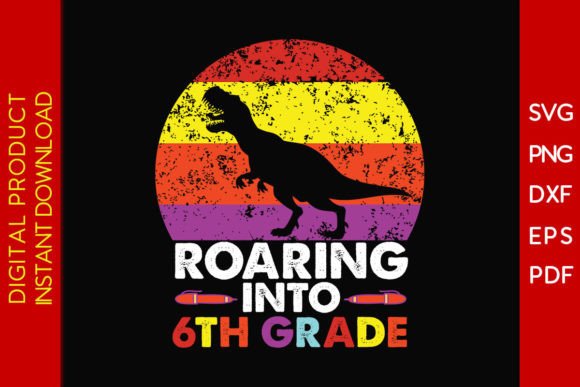
Roaring into 6th Grade Back to School
“Roaring into 6th Grade Back to School” refers to a digital design bundle featuring themed graphics—typically incorporating lions, school motifs, bold typography, and playful educational elements—intended for personal crafting use. These files are delivered in multiple vector and raster formats (SVG, DXF, EPS, PNG, PDF) inside a single ZIP archive. Once downloaded and extracted, they can be imported into compatible design or cutting software for physical application.
Why This Design Bundle May Be Relevant
Many educators, parents, and students seek age-appropriate, visually engaging materials to mark the transition to middle school. Sixth grade often represents a developmental milestone: increased independence, new academic expectations, and evolving social dynamics. A themed graphic like “Roaring into 6th Grade” supports this shift through symbolic imagery—lions evoke courage and confidence—while offering practical utility across common back-to-school projects.
Users commonly look for such assets when planning classroom decorations, personalized student welcome kits, custom t-shirts for orientation day, or memory-keeping tools like scrapbooks and greeting cards. The appeal lies not only in thematic relevance but also in format flexibility: SVG and DXF support precise cutting for vinyl decals or iron-on transfers; high-resolution PNGs allow clean printing on posters or stationery; and PDF/EPS versions suit professional printing services or vector editing workflows.
Practical Benefits and Realistic Considerations
The primary benefit is time efficiency. Instead of designing from scratch—or searching across multiple sources for cohesive, school-appropriate visuals—users gain a coordinated set of files ready for immediate use. Compatibility with widely adopted platforms—including Cricut Design Space, Silhouette Studio, Brother ScanNCut, Adobe Illustrator, and CNC plasma software—means most crafters can integrate the files without switching tools or learning new workflows.
However, several considerations affect suitability. First, the files are for personal, non-commercial use only. Those intending to sell finished products (e.g., decorated apparel or printed planners) must verify licensing terms—this bundle does not grant resale rights. Second, while the ZIP contains multiple formats, users must extract the archive before use; no cloud-based auto-extraction is provided. Third, file quality depends on correct import settings—for example, SVG layers may require ungrouping in Silhouette Studio, and PNG transparency must be preserved during print preparation.
Also note: these are static designs—not editable text templates. If customization beyond scaling, color fills, or basic layer rearrangement is needed (e.g., changing “6th Grade” to “Grade 6”), vector-editing knowledge helps. Users unfamiliar with paths, nodes, or compound shapes may find EPS or SVG edits challenging without prior experience.
When This Bundle Is a Strong Fit
This resource aligns well with users who:
- Already own or regularly use compatible cutting machines (Cricut Explore, Silhouette Cameo) or vector software and want to create consistent, on-brand decorations;
- Are preparing for a specific event—such as a 6th-grade orientation, classroom open house, or end-of-year celebration—and need cohesive visual elements across multiple mediums (wall decals, name tags, tote bags);
- Prefer one-time purchase models over subscription-based design libraries and value having permanent access to files after download;
- Work within school policies that permit personal-use digital assets and do not restrict third-party design integration.
In these cases, the bundle offers predictable output, format redundancy (reducing compatibility risk), and thematic focus—making it easier to maintain visual continuity than assembling disparate free or low-cost resources.
When Alternatives May Be Worth Exploring
Alternatives become more relevant if:
- You need fully editable, customizable text (e.g., variable names, school-specific slogans)—in which case, a blank template or editable Canva link may offer greater flexibility than fixed-vector artwork;
- Your workflow relies exclusively on mobile apps without desktop software support—some formats (like DXF or EPS) have limited mobile compatibility, and PNG-only use sacrifices cut-line precision;
- You require accessibility features (e.g., alt-text-ready SVGs, high-contrast variants, or multilingual versions)—this bundle typically includes standard visual files without built-in accessibility enhancements;
- You’re sourcing for institutional use (e.g., district-wide rollout) and need formal licensing, usage documentation, or bulk redistribution rights—most individual digital downloads don’t provide those.
Additionally, free SVG repositories or school-district-approved design toolkits may better serve users with tight budgets or strict compliance requirements. While those options may involve more curation time, they avoid licensing ambiguity and often include usage guidance tailored to educational settings.
Making an Informed Choice
Before purchasing, assess your technical environment first: confirm your cutting machine or software version supports the included formats. Check whether your intended output—vinyl decal, heat-transfer vinyl, printed poster—matches the recommended file type (e.g., SVG/DXF for cutting, PNG for print). Review the preview images carefully: ensure the lion motif, typography style, and color palette match your aesthetic goals and audience expectations (e.g., some versions lean playful, others more polished).
Also consider scalability. Because the files are vector-based, they retain clarity at any size—but complex layered SVGs may behave differently across platforms. Testing one file in your preferred software before large-scale production helps avoid surprises. Finally, reflect on long-term needs: if you anticipate using similar themes year after year, compare pricing and format consistency across grade-level bundles to identify potential savings or workflow efficiencies.
Ultimately, “Roaring into 6th Grade Back to School” serves a specific niche: crafters and educators seeking efficient, thematically aligned digital assets for hands-on, small-batch creation. Its value emerges not from novelty, but from alignment—between format support and existing tools, between symbolism and developmental context, and between file utility and real-world project scope. Evaluating it against your actual workflow, constraints, and goals—not just its visual appeal—leads to the most practical outcome.