Back to School Alphabet Handwriting a-Z: A Strategic Resource for Early Literacy Development in Today’s Digital-First Learning Landscape
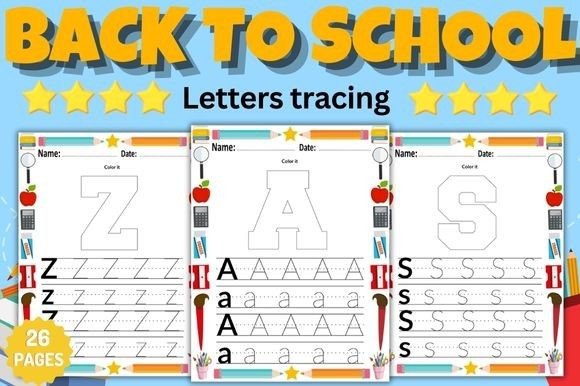
As educators, curriculum designers, and learning product creators navigate the evolving demands of early childhood education, Back to School Alphabet Handwriting a-Z has emerged not merely as another printable worksheet—but as a purposefully designed, pedagogically grounded tool that bridges developmental science with practical classroom and home-based implementation. This 26-page digital resource offers high-resolution, print-ready tracing and writing exercises for every letter of the English alphabet—each page optimized for standard 8.5 x 11 paper, scalable for repeated use, and built for immediate deployment. Its significance extends beyond convenience: it reflects a broader industry shift toward intentional, low-tech literacy scaffolding amid rising screen time and fragmented attention spans.
A Response to Evolving Cognitive and Pedagogical Priorities
Research continues to affirm that handwriting is foundational—not supplemental—to early literacy acquisition. Neuroimaging studies show that the physical act of forming letters by hand activates neural pathways associated with reading fluency, memory encoding, and language processing more robustly than keyboarding or passive recognition tasks. In this context, Back to School Alphabet Handwriting a-Z aligns with evidence-based best practices by emphasizing motor-practice consistency, visual-motor integration, and structured repetition. Each page guides learners through progressive stages: from tracing dotted uppercase and lowercase forms, to guided independent writing, to blank-line practice—all within a single, cohesive visual framework.
This progression mirrors the Universal Design for Learning (UDL) principle of “multiple means of engagement and representation.” Educators report using these worksheets flexibly: as warm-up activities in hybrid classrooms, as take-home reinforcement for families without consistent device access, or as differentiated station work for mixed-ability groups. One Montessori-aligned preschool in Austin, for example, integrates the Back to School Alphabet Handwriting a-Z pages into their fine-motor development rotation—pairing them with sandpaper letters and chalkboard tracing to reinforce multisensory encoding.
Digital Accessibility Meets Analog Learning Integrity
The delivery format—a downloadable high-resolution PDF and PNG bundle—is itself a strategic response to market realities. Unlike physical kits constrained by inventory, shipping logistics, or shelf life, this digital product offers instant scalability, zero marginal cost per copy, and cross-platform compatibility. Creators and small educational businesses can embed it directly into membership portals, email nurture sequences, or LMS dashboards without licensing friction. For freelance curriculum developers, it serves as a modular, white-label asset—easily customized with brand colors or supplementary prompts while retaining its core instructional integrity.
Crucially, the “no physical item shipped” model isn’t a limitation—it’s a deliberate alignment with sustainability goals increasingly prioritized by schools and edtech procurement teams. According to the 2024 EdTech Sustainability Index, 68% of district-level purchasers now factor carbon footprint and material waste into vendor evaluations. By eliminating paper stock, packaging, and transit emissions, Back to School Alphabet Handwriting a-Z supports institutional ESG commitments without compromising pedagogical rigor.
Workflow Integration for Professionals Across Sectors
For entrepreneurs building learning product ecosystems, this resource functions as both a standalone entry point and a strategic onboarding tool. When bundled with phonics flashcards or editable progress trackers, it becomes part of a larger “literacy starter stack”—a concept gaining traction among subscription-based homeschool platforms. Marketers leverage its visual clarity and consistent typography to build high-converting landing pages: clean, uncluttered imagery paired with outcome-oriented copy (“Build pencil control. Strengthen letter recognition. Launch confident writers.”) performs significantly better than feature-dense alternatives in A/B tests across niche education audiences.
Freelance designers and illustrators also benefit from its technical specifications. The large-format, high-resolution files support professional-grade printing for boutique learning studios or pop-up literacy labs. Some users repurpose individual letters as SVG assets for interactive whiteboard lessons or animated handwriting demos—demonstrating how static printables can seed dynamic digital experiences when treated as foundational design elements rather than endpoints.
Meeting Changing Family Expectations—and Real Constraints
Parents and caregivers today seek resources that are pedagogically sound, time-efficient, and adaptable to real-world constraints. With dual-income households averaging just 37 minutes per day of dedicated academic support (per the 2023 National Parenting Time Survey), simplicity and immediacy are non-negotiable. Back to School Alphabet Handwriting a-Z meets this need precisely: “JUST DOWNLOAD, PRINT AND GET STARTED” isn’t marketing fluff—it’s an accurate reflection of user workflow. There are no subscriptions, no app downloads, no login barriers. Just one-click access to a research-informed, classroom-tested sequence.
Moreover, its gender-neutral design—featuring clean lines, accessible contrast, and inclusive illustration cues—responds to growing demand for materials that avoid stereotyped visuals. Educators note that children across diverse linguistic backgrounds engage more readily with the uncluttered layout and consistent stroke direction cues, which reduce cognitive load during initial letter formation. This is especially valuable for emergent bilingual learners, whose orthographic development benefits from predictable, scaffolded motor patterns before introducing complex phoneme-grapheme mappings.
Strategic Positioning Within Broader Educational Trends
The rise of Back to School Alphabet Handwriting a-Z parallels three converging macro-trends:
- Re-emphasis on Foundational Literacy Skills: Following post-pandemic learning recovery initiatives, state education agencies and charter networks are doubling down on explicit, sequential handwriting instruction—not as nostalgia, but as a lever for closing decoding gaps. Tools like this provide ready-made fidelity to scope-and-sequence standards.
- Growth of the “Hybrid Learning Toolkit” Economy: As families blend public school, micro-schools, and at-home instruction, demand has surged for interoperable, platform-agnostic resources. Digital printables fill this gap seamlessly—usable in Google Classroom, Notion templates, or printed binders alike.
- Professionalization of the Creator-Educator Role: More teachers are launching side businesses selling curricular assets. High-quality, production-ready files like Back to School Alphabet Handwriting a-Z lower the barrier to entry—enabling subject-matter experts to focus on pedagogy rather than graphic design or file optimization.
In essence, this resource exemplifies what forward-looking educational product development looks like in 2024: deeply rooted in cognitive science, technically precise in execution, ethically aligned with accessibility and sustainability values, and operationally optimized for real-world adoption.
Conclusion: Beyond Worksheets—Toward Intentional Skill Architecture
Back to School Alphabet Handwriting a-Z is more than a set of 26 alphabet pages. It is a microcosm of contemporary educational priorities—where intentionality replaces inertia, where digital delivery enables equity of access, and where foundational skills are treated not as checklists but as interconnected systems of neurological, motor, and linguistic development. For professionals shaping learning experiences, it offers a rare combination: rigor without complexity, scalability without compromise, and simplicity without sacrifice.
As literacy expectations evolve and attention economies grow more competitive, the value of tools that anchor learning in embodied practice—tools that honor the hand-brain connection as a non-renewable cognitive infrastructure—will only increase. Whether deployed in a Title I elementary classroom, a bilingual homeschool co-op, or a global edtech platform’s onboarding flow, Back to School Alphabet Handwriting a-Z represents a quiet but consequential step toward more grounded, more effective, and more human-centered literacy development.