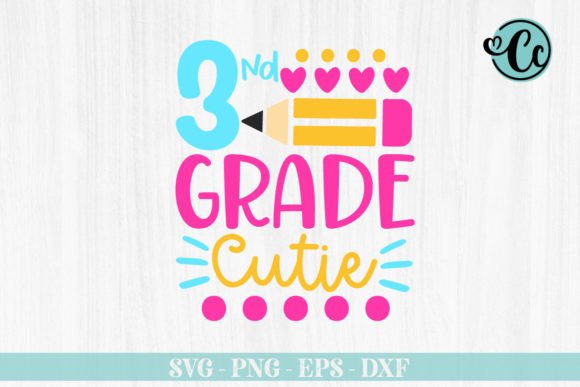
Third Grade Cutie SVG: Back to School Design for Educators, Crafters, and Small Businesses
“Third Grade Cutie SVG, Back to School” is a purpose-built digital design asset tailored for educators, small-batch apparel makers, school event coordinators, and creative entrepreneurs preparing for the new academic year. Unlike generic school-themed graphics, this file set centers on an age-specific, warmly illustrated motif—celebrating third-grade students with charm and authenticity—while delivering technical versatility across production workflows.
What It Is—and Why It Stands Out
This isn’t just another clipart download. The Third Grade Cutie SVG, Back to School package includes layered, hand-lettered vector files designed for clarity, scalability, and ease of customization. The core illustration typically features a cheerful, expressive child (often gender-neutral or adaptable) holding school supplies—notebook, pencil, backpack—with phrases like “Hello, School!” or “Third Grade Cutie” rendered in friendly, legible script. Its strength lies in intentional balance: playful enough for young learners, polished enough for professional use.
What differentiates it from free alternatives is its production-ready structure. Files are delivered in multiple formats—SVG, PNG (300 DPI), EPS, and DXF—ensuring compatibility with Cricut Design Space, Silhouette Studio, Adobe Illustrator, Canva (via SVG upload), and most DTG or sublimation workflows. Each element is cleanly separated: text, icon, and decorative accents can be edited, recolored, resized, or omitted without distortion—a practical necessity when adapting designs for mugs, classroom signs, t-shirts, or vinyl decals.
Real-World Usability Across Common Workflows
In practice, the Third Grade Cutie SVG, Back to School performs reliably across three primary use cases:
- Classroom & School Communications: Teachers print it onto welcome banners, name tags, or bulletin board headers. Because the SVG layers are editable, a third-grade teacher can swap “Hello, School!” for “Welcome to Room 214!” or add student names without redesigning from scratch.
- Small-Business Apparel & Merch: Print-on-demand sellers or local screen printers use the high-resolution PNG and vector files to produce kids’ school shirts, parent volunteer tees, or PTA fundraiser items. The 300 DPI PNG ensures crisp results on fabric; the SVG allows precise sizing for toddler vs. youth cuts.
- Educational Products & Digital Resources: Curriculum designers embed the graphic into editable Google Slides templates, printable reward charts, or digital newsletters—maintaining visual consistency while respecting branding guidelines.
Testing across platforms confirms consistent rendering: no stray anchor points, no embedded raster artifacts, and no font dependencies (all text is outlined). That eliminates common pain points—like missing fonts in Silhouette Studio or blurry scaling in Canva—making it genuinely time-saving for users who juggle multiple tools.
Quality, Flexibility, and Long-Term Value
The design’s quality is evident in its clean vector construction—not merely traced but thoughtfully built. Stroke weights remain proportional at any size; curves hold integrity down to 1-inch embroidery applications or up to 48-inch wall decals. This isn’t theoretical: users report successful use on iron-on transfers for cotton blend tees, engraved wooden signs, and even laser-cut acrylic keychains—proof of robust scalability.
Flexibility extends beyond format support. Because elements are grouped logically—not merged or flattened—customization feels intuitive. A homeschool co-op leader might remove the backpack icon and replace it with a globe for an “Around the World in Third Grade” theme. A boutique owner could adjust spacing to fit a curved mug handle or reposition the phrase for a vertical sticker layout. No advanced vector skills are required; basic layer toggling and color replacement suffice.
Long-term value emerges in reuse potential. Unlike single-use seasonal graphics, this design adapts across years: change the grade level (“Fourth Grade Cutie”), update colors to match school spirit days, or pair it with complementary SVGs (e.g., apples, pencils, or ABC motifs) for cohesive classroom kits. That reduces recurring design costs and supports brand continuity for schools or small businesses building annual back-to-school campaigns.
Who Benefits Most—and When It Might Fall Short
This asset serves best those who need both emotional resonance and technical reliability. Educators appreciate the age-appropriate tone—it avoids infantilizing third graders while still feeling joyful and inclusive. Small business owners benefit from fast turnaround: one download replaces hours of custom illustration or risky free-resource hunting. Marketing teams for tutoring services, after-school programs, or educational nonprofits find it effective for social media graphics, email headers, and printed flyers targeting families of elementary-age children.
That said, it’s not universally ideal. Users needing photorealistic imagery, multilingual text variants (e.g., Spanish or bilingual versions), or ADA-compliant high-contrast versions will need supplemental work. It also assumes basic familiarity with vector editing—if you’ve never adjusted layers in Cricut Design Space or changed fill colors in Illustrator, expect a modest learning curve (though tutorials for those tasks are widely available). And while the hand-lettered style reads well at standard sizes, extremely tight spaces—like 0.5-inch embroidery hoops—may require simplification by a designer.
Practical Recommendations for Implementation
Start by opening the SVG in your preferred editor and verifying layer organization. In Cricut, check that “cut lines” and “print layers” are correctly assigned before sending to machine. For DTG printing, export the PNG at exact dimensions needed—no upscaling. If using for signage, test the EPS version in your RIP software to confirm spot color handling.
For educators: pair the design with a simple, consistent color palette (e.g., navy, kelly green, and cream) to reinforce visual identity across handouts, slides, and physical displays. For crafters: consider combining the “Hello, School!” phrase with a coordinating border SVG for framed classroom art—this multiplies utility without extra cost.
If you’re evaluating multiple back-to-school SVGs, prioritize ones where text is outlined (not live type), where icons and lettering are on separate layers, and where the preview shows clean edges at both small and large zoom levels. The Third Grade Cutie SVG, Back to School meets all three criteria—and does so without overcomplicating the aesthetic.
Ultimately, this isn’t about novelty. It’s about having a dependable, age-aware, technically sound resource that aligns with real classroom rhythms and small-business constraints. When August rolls around and you need to produce twenty personalized welcome cards, ten matching t-shirts, and a banner for open house—all within a weekend—the value isn’t in the graphic itself, but in how smoothly it moves through your actual workflow. That’s where the Third Grade Cutie SVG, Back to School delivers consistently.