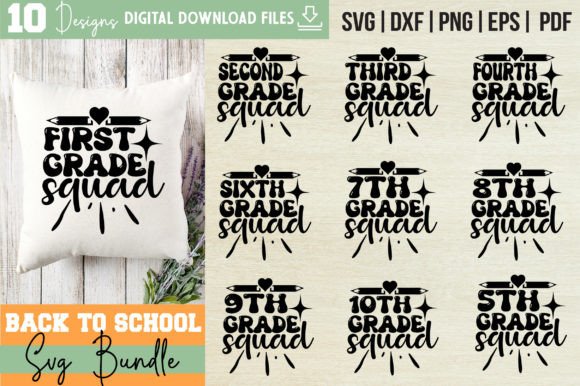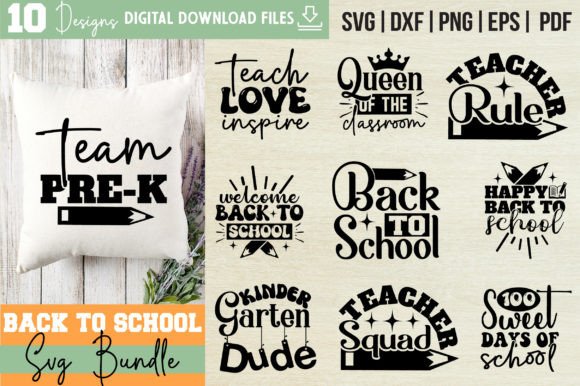
Back to School SVG Bundle Vol-2: A Versatile Digital Asset for Educators, Makers, and Small Businesses
As classrooms reopen and creative projects ramp up each August, demand surges for high-quality, adaptable design resources—especially those tailored to education-themed crafts, merchandising, and classroom engagement. The Back to School SVG Bundle Vol-2 meets this need with precision-engineered vector assets built for real-world versatility. Unlike generic clipart or low-resolution graphics, this collection delivers production-ready files designed for both digital customization and physical output across a wide spectrum of tools and materials.
What Makes This Bundle Structurally Distinct?
This isn’t a simple folder of static images. Each of the 10 included designs is delivered as a complete, layered ecosystem—starting with Word By Layer SVG Files. That means text elements, decorative flourishes, icons (like apples, pencils, graduation caps, or chalkboard textures), and background motifs are separated into discrete, editable layers. For Cricut Design Space users, this enables precise control over cut order, color assignment, and layer visibility without needing to ungroup or trace. For Silhouette Studio or Adobe Illustrator users, it allows non-destructive editing—adjusting stroke weight on a single letter, recoloring an icon independently, or deleting a background element while preserving the rest.
The inclusion of 10 EPS files reinforces professional-grade scalability. EPS remains a gold standard for print service providers and commercial sign shops because it preserves vector fidelity regardless of output size—from a 2-inch decal on a student planner to a 48-inch wall mural in a school hallway. These files retain editable paths, anchor points, and typography (when converted to outlines), making them suitable for licensed reproduction or white-label adaptation by small businesses.
Practical File Utility Across Platforms and Workflows
One of the most overlooked strengths of the Back to School SVG Bundle Vol-2 lies in its cross-platform compatibility—not just in theory, but in daily practice. Consider these real-world scenarios:
- Teachers preparing classroom materials: Use the transparent-background PNGs (300 DPI) directly in Google Slides or Canva to create printable welcome banners, editable name tags, or bulletin board headers—no background removal needed.
- Small-batch apparel entrepreneurs: Import DXF files into Glowforge or Epilog laser software to etch designs onto wooden teacher appreciation gifts, or use the SVGs in Cricut’s Print Then Cut workflow for custom iron-on transfers on cotton tees.
- Home-based stationery designers: Open PDF source files in Illustrator to modify font pairings, adjust kerning for better readability on greeting cards, or integrate client-branded colors using global swatches.
- School district communications teams: Leverage EPS assets in InDesign layouts for official back-to-school newsletters—ensuring crisp rendering at any scale, whether viewed on mobile devices or printed on letterhead.
Note that all formats—including the 10 DXF files—are natively compatible with AutoCAD-based workflows, which matters more than many realize. Architects designing learning spaces, facility managers updating wayfinding signage, or vocational educators teaching CAD fundamentals can repurpose these files as base templates for dimensional mockups or CNC routing plans.
Design Philosophy: Functionality Meets Educational Resonance
The visual language of the Back to School SVG Bundle Vol-2 avoids cliché while staying instantly recognizable. Rather than relying solely on cartoonish apples or oversized pencils, the collection balances symbolic clarity with thoughtful composition. One design might layer a minimalist chalk-drawn compass rose beneath the phrase “New Beginnings,” with each word on its own layer—allowing educators to isolate “Beginnings” for a growth-mindset poster while keeping the graphic intact. Another features a typewriter-style quote (“Learning is not attained by chance, it must be sought for with ardor and attended to with diligence”) where punctuation marks exist as separate vector objects—enabling easy substitution of em dashes for colons or swapping quotation marks for speech bubbles.
This attention to semantic structure supports accessibility-conscious design practices. When used in digital classroom content, layered SVGs can be paired with ARIA labels in HTML exports; when printed, clean vector paths ensure legibility at small sizes—critical for student handouts or resource cards meant for K–5 learners.
Real-World Implementation Considerations
Before integrating these files into your workflow, consider three practical variables:
- Software version alignment: While SVGs are broadly supported, older versions of Cricut Design Space may not recognize newer SVG attributes like nested groups or advanced clipping paths. Always test one file first—and if needed, simplify layers using Illustrator’s “Object > Path > Outline Stroke” or “Object > Expand Appearance” functions before re-exporting.
- Material-specific adjustments: A design optimized for vinyl cutting on t-shirts may require different line weights than one intended for engraving on birch plywood. The EPS and PDF source files give you full control to adjust stroke thickness, add registration marks, or convert fills to outlines depending on substrate requirements.
- Licensing scope: As a digital download only—no physical product—the bundle grants perpetual usage rights for personal, educational, and small-business commercial applications (e.g., selling 50 handmade mugs with these designs). It does not permit resale of the raw files, creation of competing SVG bundles, or use in subscription-based design services without explicit extended licensing.
Expanding Beyond Traditional Applications
While the listing highlights common uses—shirts, mugs, signs, cards, home décor, clothing, stationery, and wall art—the Back to School SVG Bundle Vol-2 lends itself to less obvious but increasingly relevant contexts:
- Digital learning kits: Teachers embed layered SVGs into interactive H5P activities—revealing vocabulary words one layer at a time during phonics instruction, or animating “school supply” icons to reinforce categorization skills.
- Augmented reality overlays: Designers import EPS assets into Unity or Spark AR to build AR filters for school orientation events—students point phones at campus landmarks to trigger animated SVG-based info panels.
- Adaptive learning tools: Special educators extract individual icon layers (e.g., a backpack, notebook, or bus) to create tactile flashcards using embossed vinyl or 3D-printed mounts—supporting multisensory engagement for neurodiverse learners.
- Community engagement campaigns: Municipal libraries use the quote-based designs in bilingual social media graphics—swapping English text layers for Spanish translations while retaining consistent visual hierarchy and spacing.
Why Format Redundancy Is a Strategic Advantage
At first glance, receiving 10 designs in five distinct formats (SVG, EPS, PNG, DXF, PDF) may seem excessive. Yet each format serves a unique functional niche:
The PNGs provide immediate usability—no software installation required, no vector knowledge necessary. They’re ideal for quick drag-and-drop use in presentation tools or email signatures. The DXF files bridge the gap between graphic design and mechanical fabrication, supporting interoperability with industrial equipment often found in makerspaces or career-tech labs. The PDF source files preserve Illustrator-native features like symbols, graphic styles, and linked assets—making batch edits across multiple designs efficient. And the EPS format remains indispensable for legacy prepress environments where PDF/X-1a compliance or PostScript interpretation is mandatory.
This redundancy isn’t bloat—it’s resilience. When a school’s preferred design platform changes, when a new printer model arrives with updated driver requirements, or when a student project pivots from screen-based to physical prototyping, having all formats on hand eliminates costly rework or licensing delays.
Final Thoughts: An Investment in Creative Agility
The Back to School SVG Bundle Vol-2 represents more than seasonal decoration—it reflects a shift toward modular, future-proof digital assets. Its layered architecture, multi-format delivery, and education-aligned aesthetics support workflows spanning pedagogy, entrepreneurship, public communication, and hands-on learning. Whether you’re printing 30 name badges for a summer camp, laser-cutting acrylic awards for a robotics team, or building a branded digital welcome sequence for incoming freshmen, the bundle provides foundational components that adapt—not just to tools, but to evolving needs. In a landscape where time is scarce and expectations are high, having reliable, editable, and semantically organized design elements isn’t a luxury. It’s operational infrastructure.