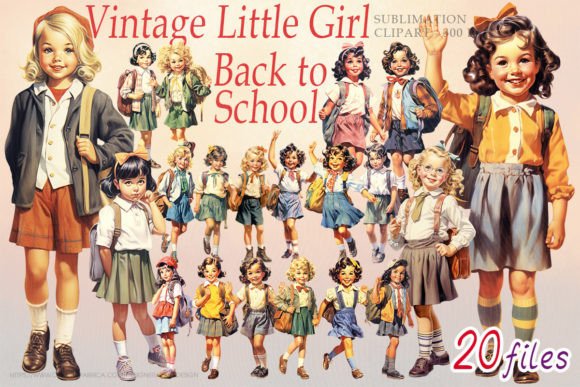
Vintage Little Girl Back to School Retro
For designers, educators, and small business owners seeking authentic, nostalgic visual assets for back-to-school campaigns, the Vintage Little Girl Back to School Retro digital download offers a focused, production-ready resource. It’s not a broad design suite or an all-in-one toolkit—but rather a tightly curated set of 20 high-resolution PNG illustrations centered on a specific aesthetic: soft-hued, mid-century-inspired depictions of young girls in classic school attire—pinafores, saddle shoes, ribboned hair, chalkboards, vintage notebooks, and retro classroom props. Its value lies in its consistency, technical readiness, and narrow thematic precision.
What You Actually Receive—and Why That Matters
The package delivers a single ZIP file containing exactly 20 PNG files—no extras, no variants, no layered PSDs or vector formats. Each image measures 5000 × 5000 pixels at 300 DPI in RGB color mode, with fully transparent backgrounds. This isn’t placeholder art or low-res web graphics. These are print-suitable assets designed for scaling without visible pixelation—even when enlarged for large-format prints like posters, banners, or fabric transfers.
Transparency is critical here: it allows immediate integration into diverse layouts—whether layered over textured paper scans in Canva, composited into editorial spreads in Adobe InDesign, or overlaid on custom backgrounds in Procreate. Unlike JPEGs or flattened designs, these files eliminate the need for time-consuming background removal or masking—saving 5–15 minutes per asset in typical production workflows.
Strengths Rooted in Practical Use
The most notable strength of Vintage Little Girl Back to School Retro is stylistic cohesion. All 20 illustrations share consistent line weight, color palette (muted teals, warm ochres, dusty pinks), and proportional rendering—avoiding the visual dissonance common in bundles assembled from disparate sources. This uniformity supports brand continuity, especially for seasonal campaigns where multiple touchpoints (social posts, email headers, printable planners) must feel like parts of a unified effort.
Another practical advantage is resolution fidelity. At 5000 × 5000 px, each file retains clarity even when cropped tightly—for example, isolating just a vintage pencil case or a chalkboard doodle for use as a social media icon or watermark. Users report successful deployment across both digital and physical outputs: printed teacher appreciation cards, enamel pin mockups, Shopify product page banners, and illustrated lesson plan templates for elementary educators.
Real-World Performance Considerations
In actual use, the set performs reliably within standard design software (Photoshop, Affinity Designer, Figma, Canva Pro) and publishing platforms. No font dependencies, embedded scripts, or proprietary effects complicate editing. Because they’re raster-based PNGs—not vectors—they aren’t infinitely scalable for ultra-large signage (e.g., 8’ × 4’ billboards), but remain fully serviceable for nearly all educational, craft, and small-business applications.
One limitation worth noting: the collection reflects a narrow demographic and era-specific interpretation. The imagery centers on a particular cultural archetype—pastel-dressed, neatly coiffed, early-to-mid 20th-century Anglo-American schoolgirl tropes. It doesn’t include diversity in skin tone, ability presentation, or contemporary schoolwear (e.g., backpacks, tablets, inclusive uniforms). For projects prioritizing modern inclusivity or global relevance, this set functions best as a stylistic accent—not a primary visual foundation.
Who Benefits Most—and How
Vintage Little Girl Back to School Retro serves professionals whose work intersects nostalgia, education, and tactile aesthetics. Teachers creating themed classroom décor often use individual elements—like a retro apple or chalkboard illustration—to build printable reward charts or bulletin board kits. Stationery designers integrate them into digital planner pages or foil-stamped greeting card templates. Etsy sellers of printable back-to-school bundles rely on such assets to add premium visual distinction without commissioning custom art.
Bloggers covering vintage lifestyle topics, homeschool curricula, or retro parenting may use the illustrations to visually anchor listicles (“10 Vintage-Inspired First-Day-of-School Traditions”) or downloadable checklists. Small publishers producing limited-run zines about childhood memory or analog learning also find utility in the cohesive tone—especially when paired with serif typefaces and scanned paper textures.
Freelancers working under tight deadlines benefit most from the “instant download” aspect. There’s no waiting for physical shipment, no licensing negotiations, and no attribution requirements beyond standard marketplace terms. Once downloaded, the files are yours to use commercially—within the scope of the original license—across unlimited projects.
Integration Tips for Better Workflow Efficiency
To maximize return on this asset set, consider these tested approaches:
- Batch-edit transparency settings: In Photoshop or Affinity Photo, apply consistent layer styles (e.g., subtle drop shadows or inner glows) across all 20 files using Actions or Macros—ensuring visual harmony without manual repetition.
- Create a master color guide: Extract dominant HEX values from three representative images (e.g., a dress, a notebook, a chalkboard) and save them as a swatch library. This ensures typography, borders, or supporting graphics align chromatically.
- Pre-size for common uses: Duplicate your working folder and generate subfolders labeled “Social,” “Print,” and “Web.” Resize copies accordingly (e.g., 1080 × 1080 px for Instagram; 2480 × 3508 px for A4 PDFs) to avoid repeated resampling during output.
- Combine with real-world texture: Overlay subtle paper grain or halftone patterns (at low opacity) to enhance the vintage feel—especially effective for digital products marketed as “handcrafted” or “analog-inspired.”
A Realistic Assessment of Long-Term Utility
This isn’t a “set-and-forget” library meant to last five years unchanged. Its long-term value depends on how well its narrow theme aligns with your recurring needs. If you produce annual back-to-school content—or regularly develop resources tied to mid-century Americana, nostalgia marketing, or gentle educational aesthetics—it’s a reusable, time-saving component. But if your projects span broader historical periods, diverse cultural references, or modern pedagogical themes, its utility remains situational rather than foundational.
That said, the creator’s stated commitment to weekly updates—including floral motifs for holidays and home-decor-focused illustrations—suggests potential for future complementary sets. Following the shop (as noted in the purchase message) may offer early access to expansions that extend the retro school theme into related contexts—like autumn harvest motifs, holiday classroom scenes, or vintage-style alphabet charts.
Ultimately, Vintage Little Girl Back to School Retro delivers what it promises: a technically sound, aesthetically unified, immediately usable set of 20 high-resolution PNGs. Its usefulness isn’t in novelty or breadth—but in reliability, consistency, and the quiet efficiency it brings to visual storytelling rooted in a very specific kind of warmth and memory.