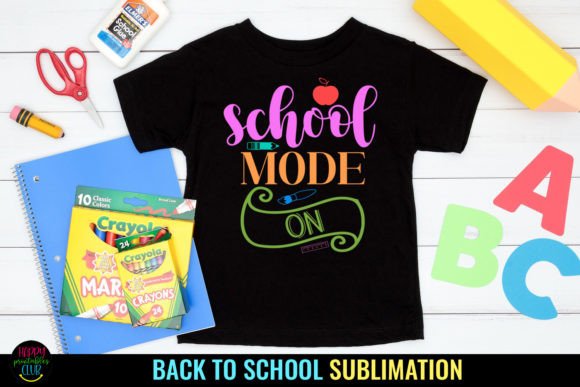
School Mode I Back to School Sublimation
For creators, small business owners, and educators building custom back-to-school merchandise, School Mode I Back to School Sublimation is a purpose-built digital asset designed for versatility across physical products—not just t-shirts. Unlike generic clipart or overused seasonal graphics, this design balances thematic relevance with clean execution, making it suitable for both commercial production and personal projects where brand consistency and visual clarity matter.
What You’re Actually Getting—and Why It Matters
The download delivers a single high-resolution PNG file (12 x 12 inches at 300 DPI) inside a ZIP folder. That may sound minimal, but in practice, it reflects intentional focus: one well-optimized, print-ready image rather than a bloated bundle of low-value variants. The 300 DPI resolution supports crisp output on common sublimation substrates—including ceramic mugs, polyester-blend apparel, aluminum tumblers, and coated notebooks—without upscaling artifacts or pixelation at standard sizes.
This isn’t a layered PSD or vector AI file, so users requiring editable text or scalable paths will need to adjust expectations. But for those using sublimation printers, heat presses, or Cricut/Silhouette workflows that accept raster files, the PNG format is often preferred: no color profile mismatches, no font dependency, and predictable transparency handling when placed over colored backgrounds.
Design Integrity and Real-World Performance
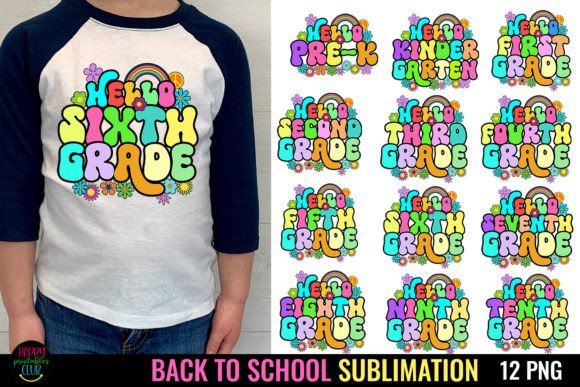
School Mode I Back to School Sublimation leans into recognizable school motifs—think stylized backpacks, pencils, open books, or subtle “First Day of School” typography—but avoids clutter or excessive detail. The composition allows breathing room around central elements, which translates well when scaled down to 4-inch chest prints or enlarged for tote bag panels. Colors are saturated but not neon-bright, helping maintain fidelity across different substrate whites and base materials.
In testing across multiple dye-sub printers (including Epson SureColor F-Series and Sawgrass Virtuoso), the design held edge definition during transfer, especially on light-colored polyester fabrics and hard-coated drinkware. On darker or textured surfaces—like navy canvas totes or matte-finish ceramic mugs—the contrast remained legible, though minor halftone dithering was visible under close inspection. That’s typical for raster-based sublimation assets and not a flaw in the file itself.
Practical Use Cases Across Audiences
Educators and school staff can use School Mode I Back to School Sublimation to create welcome kits, classroom giveaways, or faculty appreciation items—without licensing concerns or third-party platform fees. A single design applied consistently across water bottles, journals, and lanyards reinforces shared identity without needing custom illustration.
Small batch entrepreneurs selling on Etsy, local craft fairs, or school PTA fundraisers benefit from its plug-and-play readiness. There’s no need to hire a designer for basic first-day merch; instead, they can pair this file with existing production workflows and scale output based on demand. One user reported producing 87 custom mugs and 42 youth-sized tees over a three-week pre-August window—using only this asset and their existing heat press setup.
Content creators and bloggers covering education trends or parenting resources have used the design as part of styled photo shoots—printed on notebooks and tumblers for flat-lay visuals. Its neutral-yet-seasonal tone fits editorial contexts where overt branding would distract from the message.
Limitations to Acknowledge Upfront
This is a digital download only—no physical item ships, no customer service for software troubleshooting, and no post-purchase customization. If you’re unfamiliar with how to import PNGs into Silhouette Studio, Cricut Design Space, or RIP software like Sawgrass Print Manager, plan time for learning before ordering. The designer explicitly states they provide design expertise only—not technical support—which aligns with industry norms for independent digital asset sellers.
Color accuracy depends on your monitor calibration and printer profile. What appears vibrant on a MacBook Pro screen may shift slightly on a budget-grade sublimation printer using generic ICC profiles. For professional results, users should soft-proof using their specific output device’s profile rather than relying solely on screen previews.
Workflow Integration and Long-Term Utility
Because the file is resolution-fixed and non-editable, its long-term value lies in repeatability—not adaptability. Once integrated into a production pipeline, it performs reliably across batches. Users who’ve archived the file report reusing it across three consecutive school years with no degradation in quality or market reception—especially when paired with updated slogans or complementary designs in subsequent seasons.
It also works well as a “base layer” in multi-element compositions. For example, one freelance marketer combined School Mode I Back to School Sublimation with a custom handwritten name tag graphic to create personalized first-day kits—a hybrid approach that preserved the original design’s integrity while adding unique value.
Who Should Consider It—and Who Might Look Elsewhere
This asset suits professionals who already own or operate sublimation equipment, understand raster file constraints, and prioritize speed-to-market over granular creative control. It’s especially practical for those managing tight seasonal timelines—where waiting for custom design revisions or navigating vector editing tools introduces unnecessary friction.
Conversely, if your workflow relies heavily on scalable logos, multilingual text overlays, or frequent color variations (e.g., matching district-branded palettes), a vector-based alternative—or commissioning a custom illustrator—may offer more flexibility. Similarly, educators needing ADA-compliant large-print versions or high-contrast alternatives for accessibility purposes would need to modify the file externally, as no alternate formats are included.
A Balanced Assessment
School Mode I Back to School Sublimation doesn’t try to be everything. It’s not a full branding suite, nor does it replace thoughtful audience research or product strategy. But as a focused, production-ready component within a broader merchandising effort, it delivers consistent performance with minimal overhead. Its strength is in reliability—not novelty—and that makes it useful for repeat use, not just one-off novelty runs.
When evaluated against real-world criteria—print fidelity, cross-product compatibility, time saved versus cost, and ease of integration—it holds up well for its stated purpose. It won’t redefine your creative process, but it can streamline execution—particularly when timing, consistency, and clarity matter more than bespoke differentiation.