Red Apple Fruit Food Logo Back to School
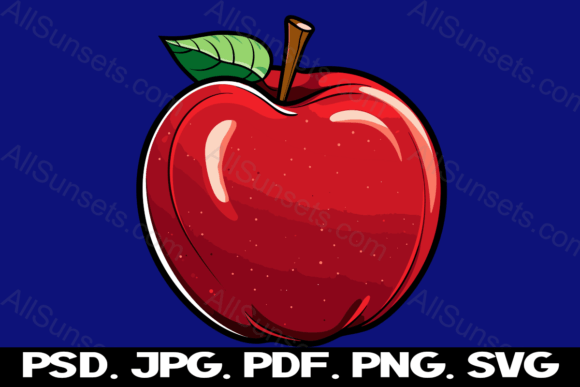
Back-to-school season isn’t just about notebooks and backpacks anymore—it’s a strategic moment for brands, educators, small businesses, and creators to reconnect with audiences through thoughtful, recognizable visuals. At the heart of that effort is the Red Apple Fruit Food Logo Back to School: a clean, versatile, and commercially ready design asset built for real-world use—not just symbolic appeal. Unlike generic clipart or overused stock icons, this logo merges food branding clarity with academic warmth, making it especially relevant for health-conscious cafeterias, nutrition educators, wellness startups, farm-to-school programs, and even boutique stationery lines targeting students and teachers.
Why This Design Fits Modern Creative Needs
Today’s creators don’t just need “a logo”—they need file flexibility, production readiness, and commercial confidence. The Red Apple Fruit Food Logo Back to School package delivers exactly that: one cohesive design in five essential formats—SVG, PNG, JPG, PSD, and PDF—each serving a distinct role in modern workflows. SVG ensures crisp scaling for responsive websites and digital signage; PNG with transparent background enables seamless layering over photos, presentations, or social media banners; high-resolution JPG supports print catalogs and email newsletters; PSD unlocks editable layers for custom color tweaks or text integration; and PDF offers universal compatibility for sharing with printers or clients who prefer vector-agnostic files.
This isn’t theoretical convenience. A freelance designer building branded lunchbox labels for a local school district can drop the PNG into Canva without worrying about jagged edges. An educator launching a classroom nutrition challenge can paste the SVG directly into Google Slides—and it’ll stay sharp on any device. A print-on-demand seller creating reusable tote bags or stainless steel water bottles benefits from the 4500 × 5400 pixel dimensions and 300 dpi resolution: no upscaling, no quality loss, no last-minute panic before a bulk order goes to press.
How File Diversity Reflects Evolving Workflows
Just five years ago, many small teams relied on a single JPG file and hoped it worked across contexts. Today, cross-platform consistency is non-negotiable—and that requires intentional format strategy. The inclusion of both SVG (scalable, code-friendly) and PSD (layered, editable) in this set reflects how professionals now move fluidly between web development, marketing automation, and physical product creation. For instance, a wellness blogger might embed the SVG in their WordPress header for fast loading, then use the PSD to add a subtle “2024–2025” badge for seasonal relevance—without altering the core asset.
Similarly, the transparent background isn’t an afterthought—it’s a necessity. Whether placing the apple logo over a photo of fresh fruit at a school farmers’ market, overlaying it on a pastel-themed Instagram Story, or integrating it into a layered Illustrator mockup for packaging, transparency eliminates manual clipping and preserves visual integrity. That saves time, reduces error risk, and maintains brand cohesion across touchpoints—something educators managing multiple grade levels and business owners juggling online and in-person sales deeply appreciate.
Commercial Use That Aligns With Real Business Priorities
Clarity around licensing matters—especially when time, budget, and reputation are on the line. The Red Apple Fruit Food Logo Back to School is explicitly cleared for commercial use, meaning it can appear on merchandise, lesson plans sold via Teachers Pay Teachers, meal kit subscription boxes, or even branded handouts distributed at PTA meetings. No hidden restrictions. No murky attribution requirements. Just straightforward, scalable utility.
This aligns with broader shifts in how small enterprises operate: leaner teams, faster turnaround expectations, and less tolerance for legal ambiguity. Consider a nutritionist launching a back-to-school webinar series. They can use the logo on their Zoom background, slide deck, downloadable checklist (PDF), and promotional postcards—all without revisiting terms of service or hiring a lawyer to vet usage rights. That kind of operational simplicity builds trust and reduces friction between idea and execution.
Design Integrity Meets Practical Scale
The dimensions—4500 pixels wide by 5400 pixels tall—are not arbitrary. They support large-format printing (think banners for school gymnasiums or cafeteria walls) while retaining ample detail for tiny applications like embroidered patches or QR-code-linked flashcards. And because the resolution is fixed at 300 dpi, there’s no guesswork involved when sending files to professional printers—a common pain point for educators ordering materials through district procurement portals or small vendors unfamiliar with digital prep standards.
That precision also signals intentionality in the asset’s creation. It wasn’t stretched from a low-res source or upscaled artificially. It was built from the ground up to perform—whether viewed on a retina-display laptop during a virtual parent-teacher conference or printed at life-size beside a salad bar in a middle school cafeteria.
Where Educators, Entrepreneurs, and Designers Converge
This logo bridges communities often siloed by tools and terminology. Teachers may not know what an SVG is—but they do know they need something that works in Google Docs and doesn’t blur when projected. Startup founders may not edit PSD files themselves—but they rely on designers who do, and having layered source files speeds up iteration cycles. Freelancers need assets that integrate smoothly into client workflows—no reformatting, no follow-up questions, no version confusion.
In practice, that means a homeschool co-op leader can download the PNG, drag it into a Canva flyer for a “Healthy Snack Swap” event, and share it instantly. A food truck operator expanding into school lunch contracts can import the SVG into their menu board software and scale it to fit a 48-inch digital display. A graphic designer pitching a rebrand for a community garden program can present the PSD version with mockups showing how the apple adapts to tote bags, seed packet labels, and Instagram highlights—all using the same foundational file.
A Resource That Grows With Your Needs
What makes the Red Apple Fruit Food Logo Back to School more than a static download is its adaptability over time. You’re not locked into a single style or season. The clean lines and balanced proportions allow for easy recoloring (via the PSD), subtle texture overlays (using the transparent PNG), or contextual pairing—like adding a chalkboard-style font beneath it for a “Learning & Nourishment” campaign. It doesn’t shout; it supports. It doesn’t date quickly; it integrates.
As schools place greater emphasis on social-emotional learning, food literacy, and sustainability, visuals that quietly reinforce those values—without cliché or condescension—gain quiet momentum. This apple doesn’t wear a graduation cap or hold a pencil. It simply *is*: ripe, approachable, grounded in real food and real learning. That restraint is increasingly valuable in a landscape saturated with forced whimsy and algorithm-driven aesthetics.
Getting Started Is Intentional, Not Immediate
There’s no pressure to use every format at once—and no penalty for starting simple. If you’re testing the logo on a single printable handout, begin with the PDF. If you’re building a Shopify store for healthy classroom snacks, start with the PNG and SVG. If you’re collaborating with a print vendor, send the high-res JPG or PDF and confirm bleed and color mode preferences upfront. The power lies in choice—not obligation.
And because the package includes no extraneous elements—no alternate versions, no unused variants, no filler—you’re not sifting through clutter to find what works. What’s here is purpose-built, production-tested, and ready to serve your goals—not someone else’s template library.