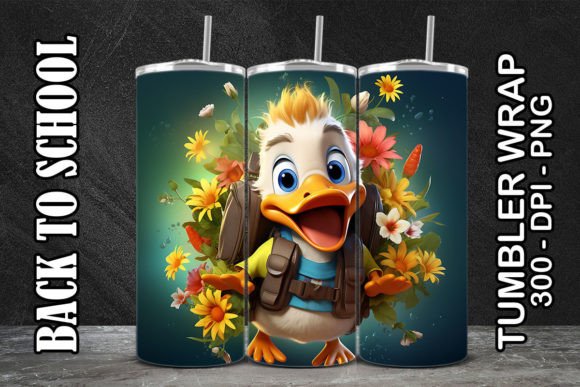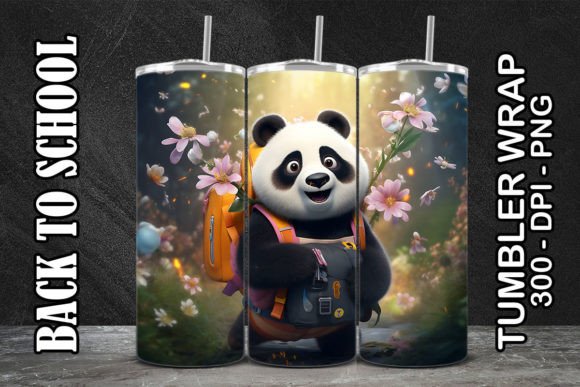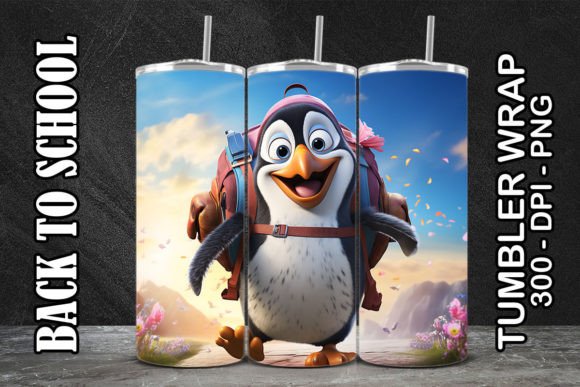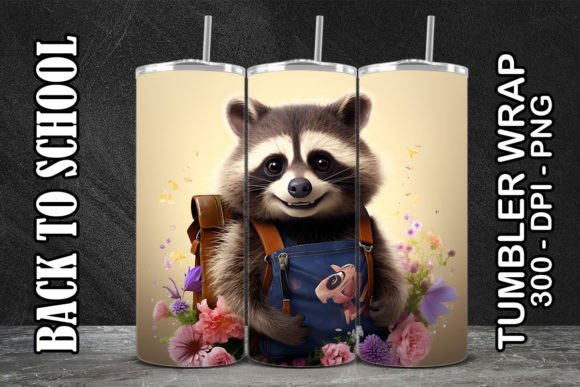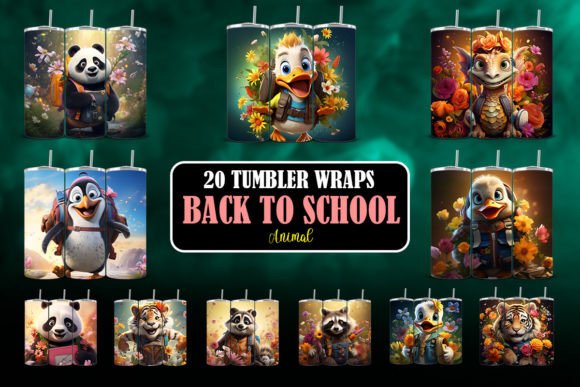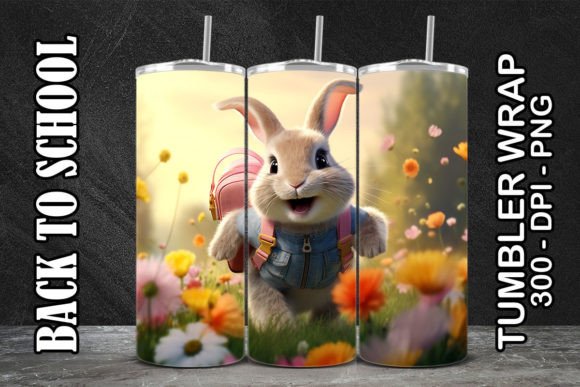
Rabit Back to School Tumbler 2
The Rabit Back to School Tumbler 2 is a purpose-built digital design asset tailored for creators and small business owners who produce custom drinkware—especially sublimation-printed tumblers aimed at seasonal markets like back-to-school. Unlike physical products or generic templates, this offering is a tightly scoped, production-ready digital file bundle: one ZIP archive containing multiple high-resolution PNGs sized precisely for tumbler wraps (9.06 in × 8.11 in at 300 DPI). It’s not a tool, app, or service—it’s a precision-crafted visual component designed to slot directly into an existing sublimation workflow.
Where It Fits in Your Production Process
For makers running tumbler businesses—whether selling on Etsy, at local craft fairs, or through school PTA partnerships—the Rabit Back to School Tumbler 2 functions as a pre-validated design layer. It bridges the gap between concept and output: no need to draft from scratch, resize repeatedly, or troubleshoot bleed margins. You receive files that are already dimensionally accurate for standard 20 oz tapered tumblers, aligned to industry-standard sublimation requirements. That means less time adjusting canvas settings in Photoshop or Illustrator, and more time fulfilling orders, testing heat press parameters, or refining your listing copy.
This isn’t a standalone solution—it’s a dependency-aware asset. Its value multiplies when paired with compatible hardware (e.g., a reliable heat press with consistent temperature control), substrates (polyester-coated tumblers), and software (design tools that preserve transparency and embedded color profiles). If your current workflow involves sourcing designs from marketplaces with inconsistent sizing or resolution, switching to a dedicated, measurement-locked file like Rabit Back to School Tumbler 2 reduces variability in print alignment and edge clarity—two common pain points during batch production.
Preparation and Compatibility Checks
Before importing the PNGs into your design or RIP software, verify three practical factors:
- Color mode: Confirm your printer profile expects RGB (standard for most sublimation workflows). The files arrive in RGB—no conversion needed if your pipeline is calibrated for it.
- Transparency handling: These PNGs include transparent backgrounds. Ensure your RIP software or print driver correctly interprets alpha channels—especially if layering text or logos over the design.
- Substrate match: The 9.06 × 8.11 in dimensions assume a standard 20 oz tumbler with a printable surface height of ~8.11 in and circumference of ~9.06 in. Measure your blank tumblers first—if yours differ by more than ±0.1 in, minor scaling may be required (though doing so risks subtle distortion).
Skipping these checks doesn’t break the file—but it can delay your first successful press run. Think of the Rabit Back to School Tumbler 2 as a precision gear: it performs optimally only when meshed with compatible parts.
Integration Into Real Workflows
Here’s how professionals actually use it—not as a one-off download, but as a repeatable node in their operational rhythm:
- Educators and school vendors: A PTA coordinator preparing spirit-day merchandise downloads the file, imports it into Canva or Silhouette Studio, adds the school mascot or grade-level text, then sends the composite to their sublimation partner. Because the base wrap is already sized and resolution-locked, turnaround from request to proof is under 45 minutes.
- Freelance designers: Someone building tumbler bundles for clients maintains a library of verified wrap files—including Rabit Back to School Tumbler 2. When a client asks for “back-to-school themed merch,” they pull this file, apply brand colors via adjustment layers, and deliver layered PSDs—cutting design iteration time by 60%.
- Small-batch entrepreneurs: A maker using a 15×15 inch heat press prints four 20 oz tumblers per cycle. They batch the Rabit Back to School Tumbler 2 files with matching coordinating designs (e.g., matching notebook or pencil cup wraps), align all four in one layout, and press simultaneously—maximizing machine uptime without compromising registration accuracy.
Notice the pattern: the file isn’t used in isolation. It’s anchored to role-specific goals—speed, consistency, scalability—and activated through deliberate integration, not passive insertion.
Quality Control and Long-Term Use
Digital assets degrade only through misuse—not age. To ensure the Rabit Back to School Tumbler 2 remains reliable across seasons and projects:
- Store it in a version-controlled folder labeled with date and use case (e.g., “Rabit_Tumbler2_BackToSchool_2024_PrintReady”). Avoid renaming the original PNGs—preserve the filename logic for quick identification later.
- Test-print one unit before full batches. Even with perfect specs, differences in ink saturation, press dwell time, or tumbler coating can shift final contrast or hue. A single test gives you calibration data you can document and reuse.
- Archive your press settings alongside the file: temperature, time, pressure, and even ambient humidity on the day of the test run. Sublimation is as much environmental science as art—context matters.
Over time, users report that having a trusted, fixed-dimension wrap file like this reduces decision fatigue. Instead of debating sizing or resolution every August, they focus energy on differentiation: adding localized slogans, bundling with teacher appreciation notes, or optimizing product photography lighting.
What It Doesn’t Do—And Why That Matters
The Rabit Back to School Tumbler 2 does not include physical tumblers, printing instructions, business licensing guidance, or marketing copy. It also doesn’t auto-adapt to non-standard sizes or alternate substrates like mugs or phone cases. That’s intentional. Its scope is narrow by design—so it delivers precision where it counts.
This focus makes it interoperable rather than self-contained. You decide whether to use it as a base layer (adding your logo), a finishing touch (applying it after a monochrome gradient background), or a consistency anchor (ensuring all “Back to School” SKUs share identical proportions and layout rhythm). Its utility emerges not from what it contains, but from how reliably it interfaces with your choices.
Getting Started Without Overhead
No setup is required beyond unzipping and opening the files in your preferred design environment. Since it’s delivered instantly after purchase, there’s no shipping delay, no inventory tracking, and no vendor coordination. For someone launching a seasonal micro-collection—or refreshing last year’s bestseller—the barrier to entry is literally seconds.
That immediacy supports iterative execution: test one design variant Monday, adjust based on customer feedback Tuesday, and ship updated mockups Wednesday. In fast-moving niches like academic-year merch, speed of iteration often outweighs perfection of first attempt. The Rabit Back to School Tumbler 2 enables that cadence—not by doing the work for you, but by removing one recurring setup task from the critical path.
If your goal is to produce professional-grade, seasonally relevant tumblers without reinventing dimensional standards each cycle, this file serves as a quiet, reliable foundation—not a flashy feature, but a functional constant.