Mouse Back to School Clipart: High-Resolution PNGs That Actually Work for Real Projects
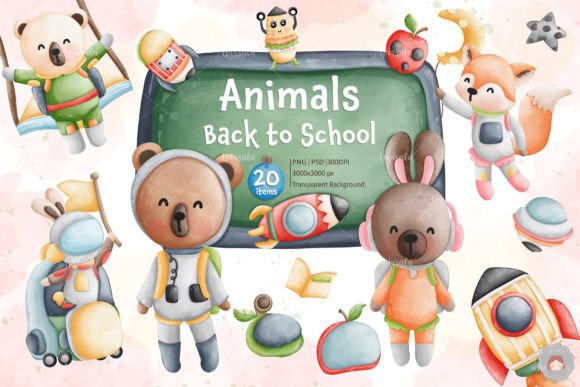
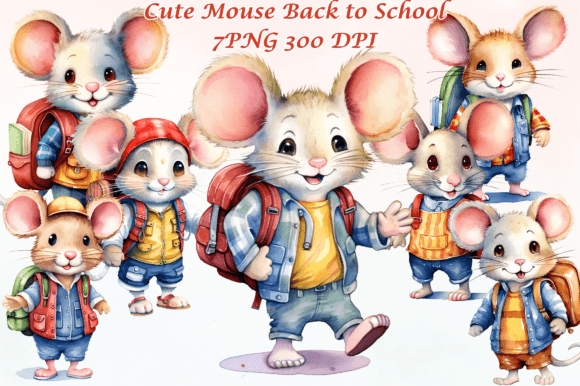
If you're designing classroom materials, launching a back-to-school merch line, or creating social media content for educators or parents, Mouse Back to School clipart isn’t just a cute idea—it’s a practical asset. These aren’t generic cartoon mice with backpacks slapped onto low-res JPEGs. You’re getting 7 professionally crafted PNG files, each sized at 3000 x 3000 pixels and rendered at 300 DPI. That means crisp edges, clean transparency, and true scalability—whether you’re printing a 24" banner or shrinking the same file for an Instagram story thumbnail.
Why This Specific Mouse Back to School Clipart Stands Out (and Why Most Don’t)
Many designers assume “back to school clipart” is interchangeable—until they try to print it. A common mistake? Downloading free mouse-themed graphics from crowded clipart sites without checking resolution, background treatment, or licensing. You’ll often find files labeled “high res” that are actually upscaled 72 DPI web images. When printed on a t-shirt or mug, those images blur, pixelate, or lose fine details like whiskers, book spines, or pencil erasers.
This Mouse Back to School clipart set avoids that pitfall entirely. Each PNG has a fully transparent background—no white boxes, no jagged edges—and every element (glasses, notebooks, apples, pencils) is hand-drawn with consistent line weight and balanced proportions. That consistency matters: if you’re building a themed worksheet series or a product bundle, visual harmony keeps your audience focused on your message—not distracted by mismatched art styles.
Three Overlooked Details That Make or Break Your Use Case
1. DPI ≠ Pixel Dimensions — And Confusing Them Costs Time and Money
It’s easy to see “3000 x 3000 pixels” and assume it’s print-ready. But without confirming DPI, you risk disappointment. For example, a 3000 x 3000 image saved at 72 DPI prints at roughly 41.7 inches wide—massive, but soft and fuzzy. At 300 DPI? It prints cleanly at 10 inches square. This set delivers both the pixel size and the correct DPI—so your printed stickers, tote bags, or lesson plan covers retain sharpness, even up close.
2. Transparency Isn’t Automatic — Even in PNGs
Not all PNGs are created equal. Some claim transparency but contain faint halos, semi-opaque anti-aliasing, or embedded backgrounds masked poorly in editing software. With this Mouse Back to School clipart, every file was exported with proper alpha channels—tested across Photoshop, Canva, and Affinity Designer. No extra cleanup needed before layering over photos, gradients, or textured paper backgrounds.
3. Licensing Clarity Is Non-Negotiable for Sellers and Educators
Free clipart often comes with vague terms like “for personal use only”—a red flag if you run a small shop selling custom teacher mugs or digital planners. This set includes clear commercial rights: you may use these files to create and sell physical products (shirts, cups, stickers, hats) or digital resources (PDF worksheets, Canva templates, online courses). No attribution required. No hidden restrictions. Just straightforward, scalable utility.
How to Use These Files Without Wasting Time—or Compromising Quality
Start by matching the file to your output goal—not your software preference. For example:
- Printing on fabric or ceramics? Use the full 3000 x 3000 version at 300 DPI in your design software. Resize only downward—not upward—to preserve clarity.
- Creating digital downloads (like editable Google Slides or TPT resources)? Import the PNG directly. Its transparency lets you drop it onto any slide background without clipping masks or eraser tools.
- Building a cohesive brand kit? Pick one mouse pose as your anchor (e.g., the one holding an apple), then use the others for variety—same style, same scale, same tone. Consistency builds recognition faster than random clipart swaps.
Avoid the temptation to heavily recolor or distort the files. These were drawn with balanced contrast and intentional shading—altering hue drastically can mute depth or make outlines disappear. Instead, adjust saturation or brightness subtly, or pair them with complementary fonts and solid-color accents for professional polish.
What to Verify Before You Download or Purchase
Before committing—even to a low-cost or “instant download” file—ask yourself three questions:
- Is the preview image actually from the final file? Zoom in on the sample. Do lines stay sharp? Are shadows smooth, not blocky? If the preview looks blurry, the source likely is too.
- Does the listing specify both dimensions and DPI? Vague terms like “print quality” or “HD” mean nothing without numbers. Legitimate high-res clipart states exact pixel size and DPI upfront.
- Are usage rights clearly spelled out in plain language? Look for phrases like “commercial use allowed,” “no attribution required,” and “physical & digital products permitted.” If it’s buried in legalese or missing entirely, walk away.
This Mouse Back to School clipart passes all three checks—and does so without upselling bundles or locking features behind paywalls. You get exactly what’s promised: seven versatile, production-ready PNGs, ready to support real work.
Final Thought: Great Clipart Serves Your Goal—Not the Other Way Around
You don’t need more clipart. You need the right clipart—ones that save time instead of costing it, enhance clarity instead of diluting it, and scale with your growth instead of limiting it. Whether you’re a homeschool parent designing flashcards, a freelance designer building a teacher-client’s branding, or a small-batch entrepreneur launching a back-to-school collection, these files remove friction—not add it.
They’re not filler. They’re functional. And when your printed cup holds up at the PTA meeting or your digital planner gets five-star reviews for its clean, cheerful visuals, you’ll know the difference high-intent, high-fidelity Mouse Back to School clipart makes.