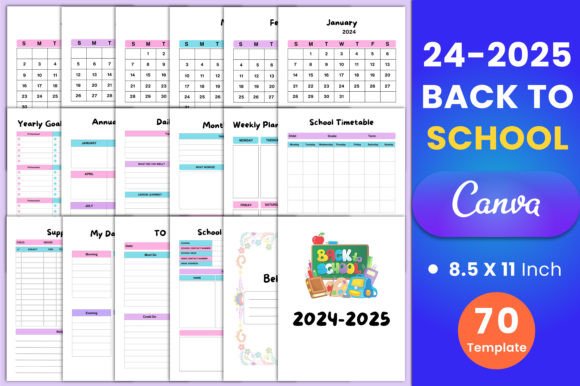
2024–2025 Back to School Canva Interior
If you're planning ahead for the upcoming academic year — whether you're a student juggling multiple courses, a parent coordinating schedules and supplies, an educator designing classroom systems, or a freelancer managing client deadlines alongside personal goals — a well-structured, visually clear, and fully editable 2024–2025 Back to School Canva Interior isn’t just helpful. It’s your quiet productivity partner.
This isn’t a generic printable PDF or a one-size-fits-all planner. It’s a thoughtfully layered digital interior built for real-life rhythm: overlapping school terms, exam windows, family commitments, study blocks, rest cues, and even those small but vital reminders — like “pack lunch” or “review notes before bed.” And because it lives in Canva, it adapts as your needs shift — no design skills required.
What People Often Misunderstand (and Why It Matters)
Many assume that any “back to school” template labeled “2024–2025” is automatically compatible with their schedule — but that’s where things get tricky. Academic calendars vary widely: some schools start in late July; others begin after Labor Day. International curricula follow different term breaks. Even within the same country, districts may align differently with national holidays or local events.
A common mistake? Downloading a beautifully designed 2024–2025 Back to School Canva Interior without checking whether its built-in calendars reflect your actual school dates — not just the default 2024 and 2025 years. If the monthly planners assume August–May but your semester runs September–June, key deadlines will drift out of sync. That misalignment doesn’t just look off — it erodes trust in your system. You’ll skip reviewing pages, ignore the timetable, and eventually abandon the whole thing.
Another overlooked detail: file versatility. Some sellers offer only static JPEGs or low-res PDFs — fine for printing once, but useless if you want to tweak colors, add logos, translate headings, or adjust layout spacing. If your 2024–2025 Back to School Canva Interior doesn’t include a true editable Canva link, you’re stuck editing by hand — or worse, recreating from scratch.
Why Format Choice Affects Real-World Use
You’ll get high-quality PDF, JPEG, and PNG files — yes — but their purpose differs. PDFs preserve typography and print cleanly. PNGs retain transparency for overlays or digital stickers. JPEGs load fast online but don’t scale well for large-format printing.
Here’s what matters most: the editable Canva version should be the *source*, not an afterthought. That’s where your customization happens — swapping fonts for accessibility, resizing grids for dyslexic-friendly spacing, adding bilingual labels, or embedding your school logo into the header. If the seller delivers only flattened image files, you lose all that flexibility — and pay full price for something you can’t truly own.
What’s Included — and What to Actually Use
The list is long — and intentionally so. But not every page serves every person. For example:
- Exam Timetable and School Timetable are essential for students — but only if they’re editable enough to match your course load (not just placeholder subjects).
- Reminders before/after school work best when personalized: “Check backpack for permission slip” hits differently than “Pack lunch.” Generic prompts fade into background noise.
- Vision Board and My Bucketlist gain power when paired with Yearly Goals and Daily Routine Tracker — otherwise, they become decorative rather than directional.
- Extra-mural Timetable and Subject List matter most for teens balancing sports, music, or tutoring — yet many templates bury them under less relevant pages like “Annual Overview,” which few actually fill out.
Look for balance: enough structure to reduce decision fatigue, but enough white space and modularity to let you prune, rearrange, or hide what doesn’t serve you.
Before You Download — 4 Practical Checks
- Verify date alignment: Does the 2024 Monthly Planner start in August or January? Does the 2025 section extend through June or stop at December? Match it to your academic calendar — not the calendar year.
- Test the Canva link: Open it on desktop or mobile. Can you edit text boxes? Resize elements? Change colors without breaking layout? If layers are locked or fonts won’t swap, it’s not truly editable.
- Scan the file types: Are PDFs print-optimized (CMYK-ready, 300 DPI)? Are PNGs transparent-background? Do JPEGs include both web-friendly and high-res versions?
- Review real-world flow: Flip through the Daily Checklist, then the Weekly Review, then the Monthly Review. Do they connect logically? Or do they feel like isolated silos?
Better Than “Just Another Planner”
A strong 2024–2025 Back to School Canva Interior does more than track time — it supports habit formation, reduces mental clutter, and gently reinforces routines without rigidity. The Reading Routine Tracker, for instance, works best when paired with your Book List and Study Tracker — turning passive reading into active learning. The Responsivity page (often missed) helps clarify roles: who handles permission slips? Who confirms parent-teacher meetings? Who updates the supply list? Clarity here prevents last-minute panic.
And because it’s built for Canva, you’re not locked in. Add your favorite icons. Swap serif fonts for sans-serif if screen reading is part of your day. Duplicate the TO DO LIST page for each child or subject. Embed links to Google Forms for self-check quizzes. These aren’t “features” — they’re natural extensions of how real people work.
So whether you’re prepping for college finals, homeschooling two grade levels, launching a tutoring business, or simply trying to reclaim calm before the bell rings — choose a 2024–2025 Back to School Canva Interior that respects your time, honors your workflow, and grows with you. Not one that looks great on Instagram, but falls apart after week three.